The Designers Republic: How Sheffield Shaped Global Graphic Design
The Studio That Changed Everything
How did a graphic design studio in Sheffield come to influence an entire generation of designers worldwide? The Designers Republic — founded by Ian Anderson in 1986 — is one of the most significant design practices to emerge from Britain in the late twentieth century, and its story is inseparable from the city that produced it.
To understand tDR, you need to understand Sheffield in the mid-1980s. The steel industry had collapsed. Unemployment was high. The city felt abandoned by the political establishment. Into this vacuum came a generation of creative practitioners who had nothing to lose and no interest in following London’s rules. Anderson, a philosophy graduate with no formal design training, was among the most determined.
The Warp Records Connection
The Designers Republic’s breakthrough came through its relationship with Warp Records, the Sheffield-based electronic music label. The sleeve designs for artists including Autechre, Aphex Twin and LFO established a visual language that was as radical as the music it accompanied. Dense, layered, typographically aggressive and deeply ambiguous, the work refused to explain itself.
The Warp sleeves were not simply illustration applied to music packaging. They were design as content — visual systems that existed independently of the music while remaining inseparable from it. Anderson’s background in philosophy informed an approach that treated graphic design as a form of cultural commentary rather than commercial service.
The Visual Language
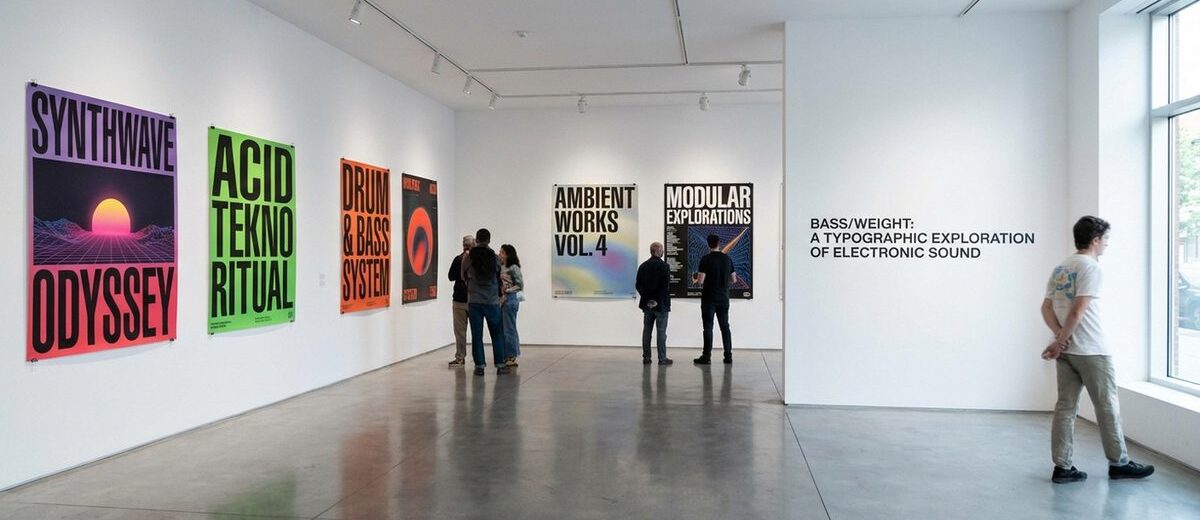
The Designers Republic developed a visual vocabulary that was immediately recognisable and widely imitated. Elements included: dense typographic compositions that challenged conventional readability, appropriated corporate imagery subverted through recontextualisation, fictional brands and logos that blurred the boundary between design and art, and a consistent use of Japanese typography that reflected the studio’s interest in information culture.
The work was frequently described as futuristic, but Anderson resisted that characterisation. He argued that tDR was not predicting the future but describing the present — a present in which information overload, brand saturation and cultural fragmentation were already realities. The designs simply made these conditions visible.
Beyond Music
While the Warp connection defined tDR’s reputation, the studio’s client list extended into gaming (Wipeout for PlayStation, which brought tDR’s aesthetic to a mass audience), publishing, fashion and corporate identity. The Wipeout commission was particularly significant — it demonstrated that radical graphic design could function within mainstream commercial contexts without compromising.
The AVPG Talk at Sheffield Design Week offered Anderson a platform to discuss this breadth of work in the city where it was produced. The Atoms, Vectors, Pixels, Ghosts exhibition went further, presenting the studio’s archive as a body of cultural work rather than a collection of commercial projects.
Sheffield as Context
Anderson has always insisted that Sheffield was not incidental to tDR’s work but essential to it. The city’s post-industrial landscape, its distance from London’s design establishment, and its culture of making provided both the context and the attitude that shaped the studio’s output. Working from Sheffield meant operating outside the conventional design economy, which in turn meant freedom to experiment.
This geographical independence had practical consequences. Without the overhead costs of a London studio, tDR could take on projects for cultural clients that would otherwise be commercially unviable. Without the social pressure of the London design scene, Anderson could pursue ideas that were unfashionable or deliberately confrontational.
Legacy and Influence
The Designers Republic closed in 2009 before being re-established by Anderson as a smaller practice. Its influence, however, continues to shape graphic design globally. The visual language that tDR developed — dense, layered, information-rich, culturally aware — anticipated the aesthetic of the internet age. Contemporary designers working with data visualisation, interface design and information architecture are all, to some extent, working in territory that tDR mapped first.
For Sheffield, tDR’s significance is both specific and symbolic. Specific because the studio demonstrated that world-class design could be produced outside London. Symbolic because it embodied a distinctly Sheffield quality: the belief that you do not need permission to do important work, and that distance from the centre is a creative advantage rather than a limitation.
The studio’s approach finds echoes in the work being done today at Sheffield’s maker spaces and by the next generation of designers graduating from Sheffield Hallam. The city continues to produce creative practitioners who value substance over style and who understand that design is a form of thinking, not just a form of decoration.
The Cultural Moment
To fully appreciate The Designers Republic, you need to understand the cultural moment from which they emerged. Sheffield in the mid-1980s was a city in transition — the old industries dying, the new economy not yet born. This interregnum created a freedom that more prosperous cities could not offer. With nothing to protect and nothing to lose, creative practitioners like Anderson could experiment without consequence.
The Warp Records connection placed tDR at the intersection of two of the most innovative cultural movements of the 1990s: electronic music and digital design. The studio’s visual language evolved in parallel with the music it packaged — both pushing towards abstraction, both interested in systems rather than narratives, both sceptical of conventional beauty.
Anderson’s decision to base the studio in Sheffield was not merely practical but philosophical. He argued that London’s design culture was compromised by its proximity to commerce — that the pressure to network, to be seen, to follow trends was antithetical to serious creative work. Sheffield’s distance from that pressure allowed tDR to develop an independent voice that was not shaped by industry expectations. This argument resonates with contemporary discussions about creative cities and the relationship between geographical location and creative freedom.
The Designers Republic’s closure in 2009 — a consequence of the financial crisis that affected many creative businesses — was a significant loss to Sheffield’s cultural landscape. Anderson’s subsequent re-establishment of the practice on a smaller scale suggests that the ideas and approach survive, even if the original studio does not. For Sheffield, tDR remains the most visible demonstration that the city can produce creative work of international consequence — a fact that continues to inspire the designers, musicians and artists who choose to work here.
