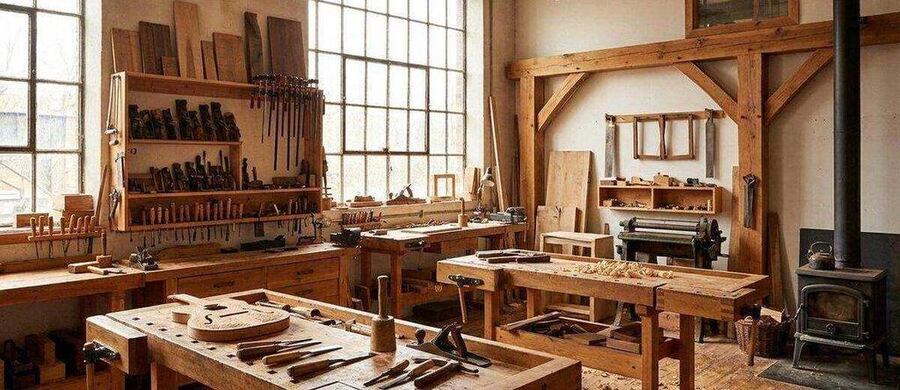
Sheffield's Maker Scene: Inside the Studios, Workshops and Open Doors
A City That Still Makes Things
Sheffield never stopped making things. While the large-scale steel industry contracted, a network of smaller workshops, studios and maker spaces grew up in its place. Today, the city’s maker scene is one of the most active in the north of England — a quiet ecosystem of silversmiths, printmakers, ceramicists, furniture makers and textile artists working in buildings that their industrial predecessors would recognise.
Persistence Works
Persistence Works on Brown Street is the anchor of Sheffield’s maker community. Managed by Yorkshire Artspace, the building houses over sixty studios occupied by artists, designers and craft practitioners. The range is remarkable — you might find a jeweller working in precious metals next door to a sculptor working in reclaimed steel.
The annual open studios event offers a rare chance to see inside these working spaces. What strikes you is the scale of the building and the density of creative activity it contains. Persistence Works functions as a small creative economy in itself, with makers commissioning work from each other and sharing equipment, knowledge and occasionally materials.
Portland Works
Portland Works on Randall Street carries particular historical weight. This is where stainless steel cutlery was first manufactured, and the building now houses a community of makers who are consciously continuing that tradition. The ChopShop Studios tour during Sheffield Design Week opened these workshops to the public.
The building was saved from redevelopment by a community share offer — residents of Sheffield literally bought into the building’s future. This ownership model gives Portland Works a stability that many maker spaces lack, and it shows in the quality of work produced there.
Exchange Works and Beyond
Exchange Works on Broad Lane, managed by S1 Artspace, provides studios at subsidised rates for early-career artists. The Sidney Street building offers similar provision. Together with Persistence Works and Portland Works, they form a network of affordable workspace that makes it possible for makers to sustain a practice in Sheffield without London-level costs.
Beyond these established centres, maker activity is scattered across the city. The Kelham Island area hosts individual workshops. Heeley and Sharrow have concentrations of independent makers. Even the suburbs contain home workshops and garden studios producing work of genuine quality.
Open Doors
What distinguishes Sheffield’s maker scene is its accessibility. Open studio events, workshops, and the city’s tradition of learning-by-doing mean that making in Sheffield is not an exclusive activity. The Craftworks exhibition and Maker Day during Sheffield Design Week both emphasised participation alongside display.
For visitors wanting to engage with Sheffield’s makers, the best approach is simply to show up. Many studios welcome visitors by appointment, and the annual open events provide a natural entry point. The work being produced is consistently strong, and the people making it are — in the Sheffield tradition — direct, generous and unpretentious about what they do.
The Economics of Making
Sheffield’s maker scene benefits from economic conditions that larger cities cannot replicate. Studio rents at Persistence Works and Portland Works are a fraction of equivalent spaces in London or Manchester. This affordability allows practitioners to sustain a making practice without relying entirely on commercial commissions — they can take time to develop work, experiment with new techniques and maintain the quality that distinguishes handmade objects from mass-produced alternatives.
The managed workspace model, where organisations like Yorkshire Artspace provide studios at below-market rates, is crucial to this ecosystem. Without subsidised space, many of Sheffield’s makers would face the choice between abandoning their practice or relocating to areas with lower costs but weaker creative communities. The managed workspaces provide both affordability and community — a combination that is essential for sustaining a viable maker culture.
Increasingly, Sheffield’s makers are finding markets beyond the city. Online sales platforms, national craft fairs and commissions from businesses and institutions across the country supplement local sales. The quality of work produced in Sheffield’s studios — informed by the city’s deep material knowledge and making tradition — competes with the best in the country. What makers gain from being in Sheffield is not a local market but a place to work well, surrounded by other practitioners who share their values.
