Sheffield Hallam and the Next Generation of UK Design Talent
Educating Makers
Sheffield Hallam University’s Sheffield Institute of Arts occupies a particular position in UK design education. It is neither the oldest nor the most fashionable design school in the country, but it produces graduates who tend to share a quality that employers and collaborators notice: they can make things. Not just conceptualise or present, but actually produce work of professional quality.
This practical emphasis reflects both the university’s polytechnic heritage and the city’s broader making culture. At Hallam, design education has always been rooted in doing rather than theorising, and the results are visible in the careers of graduates who have gone on to work across the creative industries.
The Sheffield Institute of Arts
The Sheffield Institute of Arts — SIA — brings together programmes in graphic design, product design, fine art, jewellery and metalwork, fashion, and interior design. The range is significant because it creates a cross-disciplinary environment where a graphic design student might collaborate with a metalworker, or a product designer might learn from a printmaker.
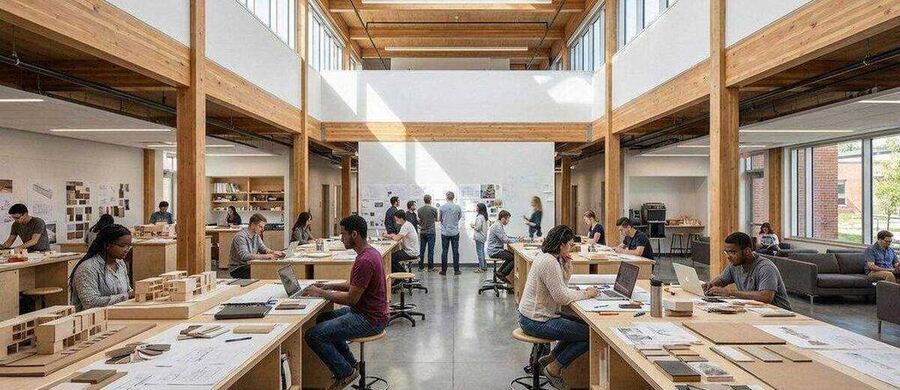
The physical facilities support this approach. Workshop spaces for metalwork, ceramics, print and digital fabrication sit alongside studio spaces for design and fine art. The annual degree show demonstrates the breadth of work produced, and it has become an important date in Sheffield’s creative calendar.
Metalwork and Jewellery
Hallam’s metalwork and jewellery programme carries particular weight in Sheffield. The course connects directly to the city’s centuries-long tradition of metalworking, and graduates regularly establish practices in the city’s maker spaces after completing their studies. Several practitioners at Portland Works and Persistence Works are Hallam graduates who chose to stay in Sheffield because the making infrastructure and community were already in place.
The programme’s strength lies in its balance of traditional skills and contemporary thinking. Students learn hand-raising, forging and casting alongside CAD modelling and laser cutting. This combination produces practitioners who understand their materials from first principles — a quality that distinguishes Hallam graduates in a field increasingly dominated by digital processes.
Graphic Design and Digital
The graphic design programme has produced notable alumni, though Hallam has never pursued the celebrity culture that attaches to some London design schools. The approach is solid and craft-focused: students are expected to understand typography, layout and production processes before they move into conceptual territory.
In recent years, the programme has expanded into motion graphics, UX design and digital publishing, reflecting the changing demands of the design industry. The Designers Republic’s influence on Sheffield’s graphic design culture is acknowledged but not fetishised — the emphasis is on developing individual voices rather than replicating a house style.
The City as Campus
What distinguishes Hallam’s design education is the city that surrounds it. Sheffield’s galleries, maker spaces and creative businesses provide a context that is difficult to replicate in a university building. Students exhibit at Site Gallery, collaborate with makers at Portland Works, and engage with Sheffield’s Design Week programme.
This porosity between university and city means that graduates are not entering the creative economy cold. They have already exhibited, collaborated and — in many cases — sold work before they complete their degrees. The transition from student to practitioner is smoother in Sheffield than in cities where the creative scene is less accessible.
Graduate Retention
One of Hallam’s quiet successes is its graduate retention rate. A significant proportion of creative graduates choose to stay in Sheffield, drawn by affordable studio space, an established maker community and a quality of life that larger cities struggle to match. This retention creates a virtuous cycle: each cohort of graduates strengthens the creative community that attracts the next.
The Sheffield Hallam events during Design Week consistently showcased this emerging talent, connecting students and recent graduates with the wider design community. It is this kind of institutional support — modest, practical, consistent — that sustains a creative city over time.
Industry Connections
Sheffield Hallam’s design programmes maintain strong connections with industry, both locally and nationally. Live briefs from commercial clients, placement years in professional studios, and visiting lecturers from leading design practices give students exposure to the realities of professional practice before they graduate.
Locally, these industry connections feed the virtuous cycle that sustains Sheffield’s creative economy. Businesses in the city hire Hallam graduates and, in turn, contribute to the university’s teaching programme. Design studios at Electric Works and across the city regularly take Hallam placement students, several of whom go on to permanent roles after graduating.
The relationship between university and city also operates at an institutional level. Hallam has been a significant presence in Sheffield Design Week from the festival’s earliest years, contributing exhibitions, talks and workshops that connected academic research with public engagement. The Design for Dementia programme was a particularly effective example of this kind of knowledge exchange — taking research from the laboratory into the public domain.
For prospective students considering where to study design in the UK, Sheffield Hallam offers a proposition that is distinct from the London schools. The teaching is rigorous and practically focused. The city provides affordable living and a supportive creative community. And the graduate outcomes — in terms of employment rates and the quality of professional practices established by alumni — demonstrate that a Sheffield design education translates into sustainable creative careers.
The relationship between the university and the wider Sheffield creative community is perhaps best understood through the annual degree show. This event, held each summer at the Sheffield Institute of Arts, functions as both an academic assessment and a public exhibition. Local businesses attend to scout talent. Established practitioners come to see what the next generation is producing. And the students themselves gain experience of presenting their work to a critical audience outside the university. It is a moment when the boundary between education and professional practice dissolves entirely — and it consistently produces surprises. The quality of work at recent degree shows suggests that Sheffield Hallam’s quiet, practical approach to design education continues to produce graduates who are ready to contribute to the creative economy from the day they leave.
