Winter Gardens Sheffield: Architecture, Events and Visitor Guide
Sheffield’s Glass Cathedral
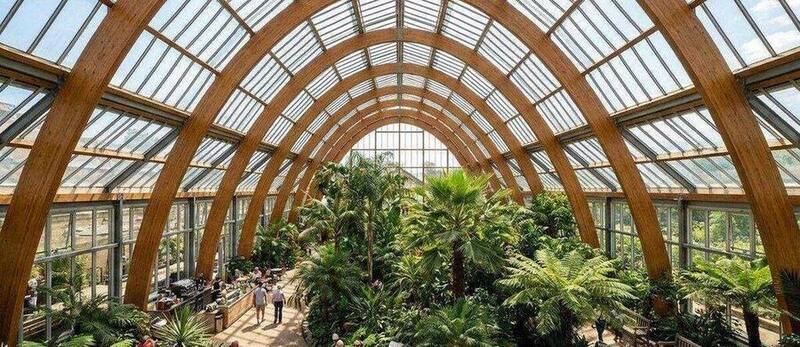
The Winter Gardens is one of the largest temperate glasshouses in Europe, and it sits in the middle of Sheffield’s city centre as though it has always been there. Completed in 2003 to a design by Pringle Richards Sharratt, the building houses over 2,500 plants from around the world beneath laminated timber arches that span 22 metres without internal supports.
The engineering is impressive, but what makes the Winter Gardens work is something simpler: it is a free, public, warm, green space in a northern English city. On a grey February afternoon, walking into the gardens feels like stepping into a different climate. That quality — generous, accessible, democratic — is what Sheffield does best.
The Architecture
The building’s structure consists of a series of parabolic timber arches, each fabricated from glue-laminated larch. The arches are the dominant visual element, and their curved forms create a volume of space that feels organic rather than engineered. The glass panels between the arches admit daylight without excessive heat gain, maintaining conditions suitable for the temperate planting.
From the outside, the Winter Gardens reads as a transparent volume connecting the Millennium Gallery to Surrey Street. This permeability is deliberate — the building functions as a covered street as much as a botanical attraction, drawing pedestrians through its length throughout the day. The Cultural Quarter architecture analysis explores how this connectivity works within the wider ensemble.
The Planting
The plant collection ranges from familiar temperate species to specimens from the Americas, Africa and Australasia. Mature tree ferns create a canopy effect that enhances the sense of enclosure, while ground-level planting provides texture and colour throughout the year. The bamboo grove at the northern end of the building reaches the full height of the arches.
The planting is managed by Sheffield Botanical Gardens Trust and is maintained to a standard that keeps the gardens looking established despite the building’s relative youth. Seasonal planting refreshes the ground-level displays, ensuring that repeat visits are rewarded.
Events and Use
The Winter Gardens serves as an events venue as well as a public garden. The central nave accommodates markets, performances and installations. The Design Platform at Winter Gardens during Sheffield Design Week demonstrated how the space could be used for design exhibitions, with the planting providing a distinctive backdrop that no conventional gallery could match.
On any given day, the gardens host an informal mix of activities: people reading, eating lunch, meeting friends, sheltering from rain, or simply sitting among plants. This unprogrammed use is arguably the building’s greatest success — it has become part of Sheffield’s daily life in a way that many public buildings aspire to but few achieve.
Visiting
The Winter Gardens is open daily and admission is free. The building is located between Surrey Street and the Millennium Gallery, accessible from Tudor Square or the Peace Gardens. No booking is required. The gardens are at their most atmospheric in the early morning, before the main flow of pedestrian traffic, and on winter afternoons when the contrast between the warmth inside and the cold outside is most pronounced.
Architecture and Engineering
The Winter Gardens repay close architectural attention. The laminated timber arches, fabricated from sustainably sourced larch, were at the time of construction among the largest of their kind. Each arch is formed from multiple layers of timber, bonded together to create curved structural members that combine strength with visual elegance. The decision to use timber rather than steel gives the building a warmth and naturalness that a metal structure would lack.
The glazing system is equally considered. The glass panels are supported by a secondary structure of steel cables and brackets that reads as minimal against the timber arches. The effect is of a building that is almost entirely transparent — a glass volume defined by its wooden skeleton. On sunny days, the shadow patterns cast by the arches onto the planting below are constantly changing, creating a visual experience that is never quite the same twice.
The building’s environmental performance is managed without mechanical air conditioning. Natural ventilation, provided by openable panels at high level and by the temperature differential between the heated interior and the exterior, maintains conditions suitable for the planting throughout the year. This passive approach to climate control is both environmentally responsible and experientially pleasant — the air in the Winter Gardens feels alive in a way that mechanically conditioned spaces do not.
The Winter Gardens is sometimes described as Sheffield’s living room, and the description is apt. It is a space where the city gathers — not for any particular purpose but simply to be together in a warm, green, public space. In a city that values honesty and directness, the Winter Gardens succeeds by being exactly what it appears to be: a generous gift from the city to its people.
