Inside the Architecture of Sheffield's Cultural Quarter
Where the City Performs
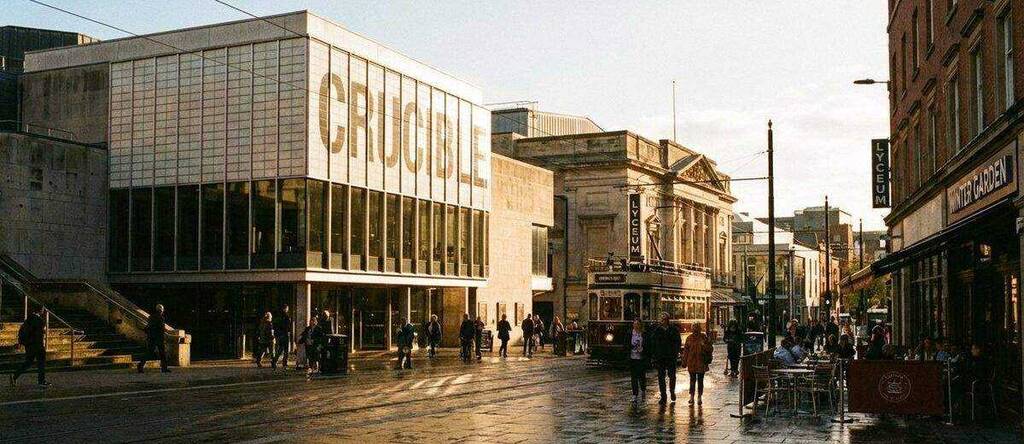
Tudor Square sits at the heart of Sheffield’s cultural life like a stage waiting for its next act. The buildings that surround it — the Crucible Theatre, the Lyceum Theatre, the Central Library and the Millennium Gallery — represent different eras of architectural ambition, yet together they create something greater than any individual structure.
I first became aware of the Cultural Quarter as an architecture student at Sheffield Hallam, walking through the square on my way to lectures. It took years before I properly looked at what surrounded me. Once I did, I found a masterclass in how cities build for public culture.
The Crucible: Concrete and Performance
The Crucible Theatre, completed in 1971 to a design by Renton Howard Wood Levin, is Sheffield’s most architecturally distinctive cultural building. Its thrust stage — one of the first in Britain — demanded a building form that broke with theatrical convention. The result is a concrete structure that feels both monumental and intimate, its angular exterior giving way to a surprisingly warm auditorium.
The theatre’s relationship with the square is considered. Its entrance draws you in from ground level, and the building’s massing steps back as it rises, avoiding the overbearing quality that many theatres of this period possess. Standing in Tudor Square and looking at the Crucible, you see a building that knows its place in the city without being deferential.
The Lyceum: Victorian Confidence
Next door, the Lyceum Theatre offers a very different architectural proposition. Designed by W. G. R. Sprague and opened in 1897, it is an exercise in late-Victorian theatrical confidence — ornate plasterwork, a grand proscenium arch, and a facade that announces itself with the assurance of an era that believed in civic display.
The Lyceum was nearly lost. Closed in 1969 and threatened with demolition, it was saved by a sustained public campaign and restored in 1990. The restoration was sensitive and thorough, and the building now stands as evidence that heritage preservation and contemporary cultural programming are not incompatible.
The Millennium Gallery
Completed in 2001, the Millennium Gallery by Pringle Richards Sharratt bridges the gap between Tudor Square and the Winter Gardens behind it. The building’s long, low form creates a covered street — a gallery that you can walk through as well as visit. This permeability is its greatest architectural achievement.
The metalwork collection housed within connects directly to Sheffield’s industrial identity. Displaying the gallery’s holdings of cutlery and silverware alongside contemporary exhibitions creates a dialogue between the city’s past and present that feels natural rather than forced. The Craftworks exhibition during Design Week used this space to particularly strong effect.
The Central Library and Winter Gardens
The Central Library, rebuilt in 2001 alongside the Winter Gardens, completes the Cultural Quarter’s architectural ensemble. The library’s curved glass facade reflects the gardens’ timber structure, creating a visual conversation between two buildings that serve very different purposes but share a commitment to public space.
The Winter Gardens themselves — one of the largest temperate glasshouses in Europe — are an engineering achievement as much as an architectural one. The laminated timber arches span the full width of the building without internal supports, creating a volume of space that surprises visitors every time they enter.
Reading the Quarter
What makes Sheffield’s Cultural Quarter architecturally significant is not any single building but the ensemble. Victorian theatricality, brutalist boldness, and contemporary transparency sit side by side, connected by a public square that works. Tudor Square itself — open, flexible, populated — is the architectural argument made physical: that culture belongs in the middle of the city, accessible to everyone who walks through.
The Love Architecture events during Sheffield Design Week often used the Cultural Quarter as a starting point for broader conversations about how the city builds for public life. It remains the best place in Sheffield to understand what architecture can do when it serves a civic purpose.
The urban design of the Cultural Quarter deserves attention beyond its individual buildings. Tudor Square functions as an outdoor room — defined on three sides by cultural buildings and open on the fourth to the commercial city centre. This spatial quality is not accidental. The square was redesigned in the early 2000s as part of the Heart of the City scheme, and the paving, lighting and street furniture create a public space that works throughout the day and across seasons.
On a summer evening, Tudor Square fills with theatre-goers, diners and people simply enjoying the space. On a winter morning, its openness allows views across to the Town Hall tower and the hills beyond. The square accommodates performance, protest, markets and quiet sitting with equal ease — a flexibility that reflects good urban design rather than expensive technology.
The relationship between interior and exterior spaces in the Cultural Quarter is particularly well managed. The Millennium Gallery’s transparent facade allows views into the exhibitions from the square. The Winter Gardens’ glass walls dissolve the boundary between planted interior and paved exterior. The Crucible’s entrance draws you from the open square into the intimate theatre lobby. Each transition is handled with the kind of spatial intelligence that makes public buildings feel welcoming rather than intimidating.
For architecture students and practitioners, the Cultural Quarter provides a case study in how different eras of building can coexist productively. The Victorian theatricality of the Lyceum, the brutalist conviction of the Crucible, and the contemporary transparency of the Millennium Gallery and Winter Gardens are not in competition. They complement each other, creating an ensemble that is richer than any single building could be. It is this layered quality — historical, architectural, social — that makes Sheffield’s Cultural Quarter one of the most rewarding public spaces in any English city outside London.
