Sheffield Train Station Through a Designer's Eye
More Than a Place to Catch a Train
Is Sheffield’s train station architecturally significant? The question might seem unlikely, but the building — or rather, the accumulation of buildings — that forms Sheffield Midland Station tells a story about the city’s ambitions, compromises and relationship with the wider world that rewards attention.
The station has been Sheffield’s primary railway terminus since 1870, and its architecture reflects over a century of additions, modifications and partial rebuilds. Like the city itself, it is layered rather than unified — a building that makes more sense when you understand its history.
The Victorian Station
The original Midland Station, designed by Charles Trubshaw for the Midland Railway Company, opened in 1870. The surviving elements of Trubshaw’s design — the entrance facade on Sheaf Street with its arched windows and stone dressings — represent solid mid-Victorian railway architecture. The building announced Sheffield’s connection to the national railway network with appropriate civic confidence.
The station replaced an earlier terminus and was designed to handle the traffic of a city at the peak of its industrial power. Steel, cutlery and manufactured goods flowed outward; raw materials, passengers and commerce flowed in. The station was Sheffield’s interface with the world, and its architecture needed to convey both competence and ambition.
The Twentieth-Century Additions
The 1960s brought significant changes to Sheffield station. A new concourse and platform canopies replaced some of the Victorian infrastructure, and the approach roads were reconfigured to accommodate increased car traffic. These additions are functional rather than distinguished, but they gave the station a capacity it would not otherwise have had.
The most visually prominent twentieth-century element is the former Sheffield Victoria Hotel, now the Mercure Sheffield St Paul’s. The hotel building, while not architecturally remarkable, contributes to the station’s urban presence and maintains the Victorian tradition of pairing railway stations with adjacent hotels.
Design Details
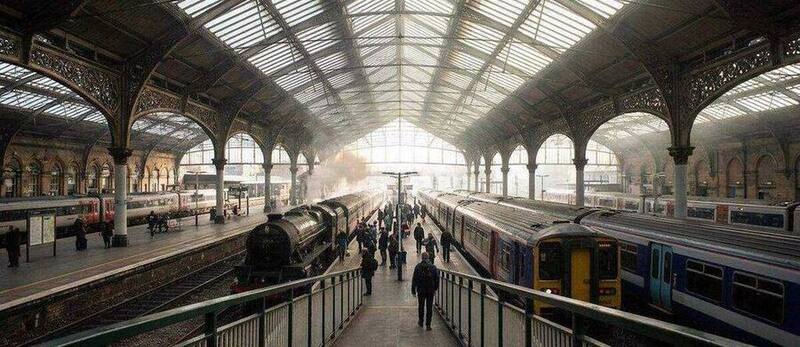
The station rewards close looking. The surviving Victorian ironwork on the platform canopies has a decorative quality that mass-produced modern structures lack. The stone detailing on the Sheaf Street facade shows the kind of considered craftsmanship that Sheffield’s design tradition values. Even the 1960s signage, where it survives, has a period charm that is increasingly rare on the national network.
Inside, the concourse has the slightly impersonal quality of many British stations, but the sightlines to Park Hill from the platform ends are remarkable. The estate’s concrete terraces rise directly above the station, creating one of the most dramatic views from any English railway platform.
The Station’s Future
Plans for the station quarter regeneration will significantly alter the station’s setting and possibly the building itself. HS2, if it reaches Sheffield, would require substantial new infrastructure. Even without high-speed rail, the proposed development of the station approach area will change how the building relates to the city.
The challenge for any redesign is respecting what already works while addressing what does not. The Victorian facade is worth preserving. The platform views are an asset. The pedestrian connections to the city centre — currently poor — need fundamental improvement. Good design can achieve all of this, but only if the station is understood as an architectural and urban design problem rather than simply an engineering one.
Getting There
Sheffield station is served by East Midlands Railway, CrossCountry, Northern Trains and TransPennine Express. It is approximately two hours from London St Pancras and one hour from Manchester Piccadilly. The station is a ten-minute walk from the city centre, though the route could be more clearly signed and more pleasantly designed — a point that the regeneration plans aim to address.
Railway Architecture in Context
Sheffield station sits within a broader tradition of Victorian railway architecture that includes some of the most impressive buildings in Britain. It cannot compete with the Gothic grandeur of St Pancras or the engineering ambition of Paddington, but it was never intended to. Sheffield Midland was designed as a working station for a working city — dignified rather than spectacular, solid rather than showy.
This quality of honest restraint is itself architecturally interesting. The Midland Railway Company’s house style tended towards the practical and the well-proportioned rather than the flamboyant. Charles Trubshaw’s design for Sheffield expressed civic respectability without extravagance — an approach that mirrored the values of the city’s industrial elite, who prised competence over display.
The station’s significance today lies partly in what it reveals about Sheffield’s relationship with national infrastructure. The city’s railway connections have always been a source of frustration — the trans-Pennine route is slow and unreliable, and Sheffield’s position slightly off the main north-south axis has meant that it is sometimes bypassed by fast services. The station’s architecture, solid but not spectacular, reflects a city that has been consistently underserved by national transport investment.
For design enthusiasts, the station is worth visiting not as a destination in itself but as a starting point. The view from Platform 1 towards Park Hill is one of the most dramatic urban panoramas in England. And the walk from the station to the Cultural Quarter, while currently unlovely, passes through the area of the city most likely to change in the coming decade. Visiting now provides a baseline against which future transformation can be measured.
