Sheffield's Brutalist Heritage: A Self-Guided Walking Tour
A City Built in Concrete
Sheffield’s relationship with brutalist architecture is more complicated than most cities would care to admit. Walk through the city centre and you will encounter buildings that provoke strong reactions — from fierce loyalty to outright hostility. That tension is precisely what makes a walking tour of Sheffield’s brutalist heritage so worthwhile.
I have spent years walking these routes, and what strikes me each time is how these buildings refuse to be ignored. They demand engagement. Whether you admire them or not, they tell a story about a city that believed in bold public architecture at a time when ambition was not a dirty word.
Park Hill: The Starting Point
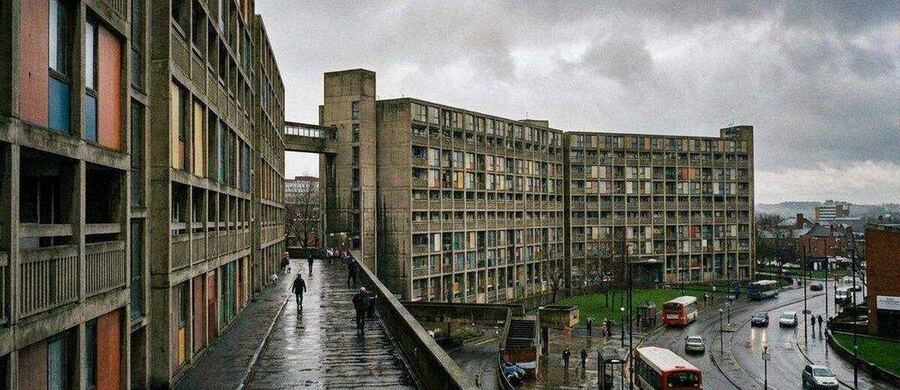
Any serious tour of Sheffield’s brutalist architecture begins at Park Hill. Visible from the train station, the estate rises above the city like a concrete hillside village. Designed by Jack Lynn and Ivor Smith and completed in 1961, Park Hill was built on the principle that working-class families deserved homes with views, light and access to their neighbours.
The famous streets in the sky — elevated walkways wide enough for milk floats — were a direct response to the back-to-back terraces they replaced. Grade II* listed since 1998, Park Hill is now undergoing phased regeneration by Urban Splash. The contrast between the restored Phase 1 with its coloured panels and the raw concrete of the unrenovated sections makes the architectural conversation visible.
Stand at the south-east corner and look back towards the city. On a clear day, the view across to the Cathedral and the Winter Gardens is extraordinary. This was the whole point — the architects believed everyone deserved this view, not just those who could afford a house on the hill.
Hyde Park and Kelvin Flats: The Lost Landmarks
From Park Hill, walk north along Duke Street towards Hyde Park. Or rather, towards where Hyde Park stood until its demolition in 1992. The estate’s twin towers were a familiar part of Sheffield’s skyline for three decades. Their absence is itself a kind of monument — to the political and social forces that turned against high-rise social housing.
The Kelvin Flats, demolished in 1995, tell a similar story. Both estates represented genuine attempts to solve the city’s housing crisis, and both became symbols of that approach’s limitations. The Beauty and the Brutal exhibition during Sheffield Design Week explored these contradictions with real nuance.
The Civic Centre and Town Hall Extension
Head west along Arundel Gate to reach Sheffield’s civic buildings. The Town Hall Extension, completed in 1977, sits in deliberate contrast to the Victorian Town Hall next door. Its horizontal concrete bands and recessed windows are textbook brutalism — honest about its materials and unapologetic about its presence.
Across the road, the former Castle Market site is now being redeveloped as part of the Castlegate regeneration. The original market building, demolished in 2015, was another brutalist landmark that divided opinion. Its curved concrete form had a sculptural quality that photographs rarely captured.
The University Quarter
Continue west towards the University of Sheffield campus, where the Arts Tower stands as the tallest university building in Britain. Completed in 1966, its slender form and exposed concrete frame are best appreciated from Western Bank, where the full height becomes apparent against the sky.
Nearby, the now-demolished Hicks Building and the Grade II listed Western Bank Library complete a cluster of post-war university buildings that demonstrate how brutalism adapted to educational settings. The library’s deep-set windows and textured concrete panels reward close inspection.
Walking the Route
The full walk covers roughly four miles and takes two to three hours at a comfortable pace. Start at Sheffield station, head to Park Hill, loop through the city centre past the civic buildings, and finish at the university quarter. Each building tells part of a larger story about Sheffield’s ambitions, compromises and ongoing conversation with its own skyline.
Understanding the Context
Sheffield’s embrace of brutalist architecture was not arbitrary. The city’s post-war housing crisis was acute — tens of thousands of people lived in back-to-back terraces with shared outdoor toilets, inadequate sanitation and no private green space. The slum clearance programmes of the 1950s and 1960s demanded replacement housing at a scale and speed that only system-built concrete construction could deliver.
The architects who designed Park Hill, Hyde Park and the Kelvin Flats were responding to a genuine emergency with the tools and ideals available to them. They believed in communal living, in shared public space, in the idea that architecture could shape a more equitable society. That some of these buildings subsequently failed — socially if not structurally — does not invalidate the ambition. It complicates it, which is why these buildings continue to provoke such strong responses.
The brutalist buildings that survive — Park Hill, the Arts Tower, the Town Hall Extension — are not relics of a failed experiment. They are evidence of a particular moment in Sheffield’s history when the city dared to think big about housing, education and civic life. Walking among them, you encounter that ambition directly, expressed in concrete, steel and glass. Whether you find it beautiful or brutal is, in many ways, beside the point. What matters is that you engage with it.
The contrast between Sheffield’s brutalist heritage and its Victorian architecture is itself instructive. The Cutlers’ Hall, the Town Hall and the Lyceum Theatre express civic pride through ornament and display. The brutalist buildings express it through scale, honesty and a democratic insistence that public buildings should serve everyone equally. Both approaches have their merits, and Sheffield is one of the few English cities where you can experience both in such concentrated proximity.
For those interested in the broader architectural context, the Cultural Quarter offers a different but complementary perspective on how Sheffield builds for public life. And the complete guide to listed buildings places these brutalist structures within the city’s wider heritage.
