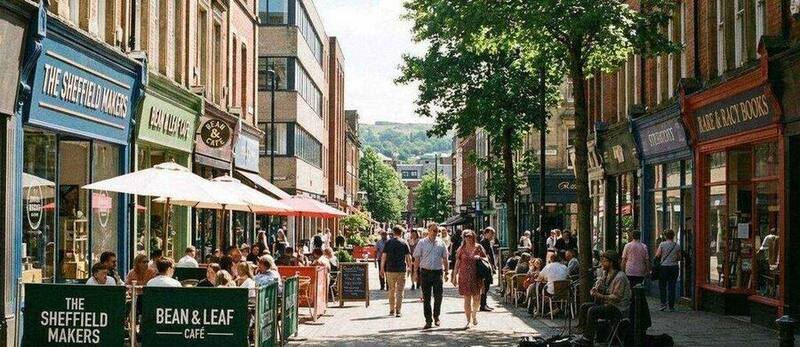
A Design Lover's Weekend Itinerary for Sheffield
Two Days of Architecture, Making and Culture
Sheffield is not a city that sells itself hard to visitors. It does not have the marketing budget of Manchester or the heritage branding of York. But for anyone with a serious interest in design — architecture, craft, visual culture, industrial heritage — it offers a weekend of genuine substance. This guide maps out two days of design-focused exploration, covering the buildings, galleries, studios and spaces that make the city worth visiting.
Saturday Morning: The Cultural Quarter
Start at Tudor Square, the heart of Sheffield’s Cultural Quarter. The Crucible Theatre, the Lyceum and the Central Library surround you — three eras of civic architecture in one public square. Walk through the library and into the Winter Gardens, whose laminated timber arches and tropical planting create one of the most impressive public interiors in any English city.
From the Winter Gardens, enter the Millennium Gallery. The metalwork collection is essential viewing — Sheffield’s industrial design heritage displayed with care and intelligence. Allow an hour, or more if the temporary exhibition programme appeals.
Saturday Afternoon: Kelham Island
Head north to Kelham Island, walking along the River Don. The Kelham Island Museum deserves a proper visit — the River Don Engine alone justifies the trip. The surrounding streets offer lunch options in converted industrial buildings, each retaining enough original character to remind you where you are eating.
After lunch, walk to Portland Works on Randall Street. If studios are open, this is your chance to see silversmiths, jewellers and printmakers at work in the building where stainless steel cutlery was first made. The connection between historical making and contemporary practice is tangible here.
Saturday Evening
The Showroom Cinema in the Cultural Industries Quarter is Sheffield’s independent cinema and an architectural conversion worth seeing in its own right. The programme is reliably good, and the bar is a meeting point for the city’s creative community. Alternatively, the Crucible Theatre or Lyceum may have something on — check programmes in advance.
Sunday Morning: Park Hill and the Station
Begin Sunday at Park Hill, visible from the railway station. The estate is accessible on foot and rewards exploration. The contrast between the renovated sections and the raw concrete of the remaining phases is one of the most visually striking encounters in any English city.
From Park Hill, walk through the city centre to the listed buildings along Church Street — the Cathedral, the Cutlers’ Hall, and the Town Hall. This short walk covers five centuries of Sheffield’s architectural ambition.
Sunday Afternoon: Abbeydale and the South
Take the bus or drive south to Abbeydale Industrial Hamlet. This preserved scythe-making works is one of the most complete industrial heritage sites in England. The water wheels, forges and grinding hulls demonstrate the processes that built Sheffield’s global reputation.
On the way back, stop along Abbeydale Road for the independent shops and cafés that have made this street Sheffield’s most interesting retail destination. End the weekend with a clear understanding of why Sheffield’s design culture has the depth and groundedness that it does.
Practical Notes
Sheffield is compact enough that most city-centre attractions are walkable. The Kelham Island area is a fifteen-minute walk from Tudor Square. Park Hill is a ten-minute walk from the station. Most galleries are free. The Kelham Island Museum charges a modest admission. Studios are generally accessible during published open hours or by arrangement.
Alternative Routes
The itinerary above covers the essentials, but Sheffield rewards deviation. If your interests lean more towards contemporary design than industrial heritage, replace Abbeydale with an afternoon in the Cultural Industries Quarter — the Site Gallery, the Showroom Cinema and the surrounding streets contain Sheffield’s concentration of digital and creative businesses.
For architecture enthusiasts, extending Saturday morning to include a walk along Glossop Road and through Broomhill provides access to the University of Sheffield campus, where the Arts Tower and the Western Bank Library add to the brutalist narrative. The journey also passes through one of Sheffield’s most characterful residential areas, with Victorian terraces and independent shops.
If the weather is good — and Sheffield, despite its reputation, has as many dry days as most English cities — the western edge of the city offers a design perspective of a different kind. The Rivelin Valley, Forge Dam and the Porter Valley contain the remains of Sheffield’s water-powered industries: grinding wheels, dams and weirs that represent the earliest industrial design in the region. These sites are accessible on foot and provide a green counterpoint to the urban design focus of the city centre.
Whatever route you choose, Sheffield rewards curiosity and a willingness to look carefully. The city does not present its design heritage on a plate. You need to seek it out, read the buildings, notice the details and make connections between what you see and what you already know. This active engagement is part of what makes a design-focused visit to Sheffield different from conventional tourism — and ultimately more rewarding.
Sheffield’s design heritage is not a curated experience. It is a living city where architecture, making and creative culture overlap with everyday life. The person serving your coffee in Kelham Island may be a ceramicist. The building housing your hotel may have produced cutlery a century ago. The gallery you visit may occupy a space where steel was once forged. These connections — between past and present, between making and living, between design and the everyday — are what make Sheffield genuinely interesting to anyone who cares about how cities work. A weekend is enough to discover them. Coming back is what happens when you realise there is always more to find.
